
Strength Training on Ozempic: The Non-Negotiable Nobody Prescribes
Jul 24, 2026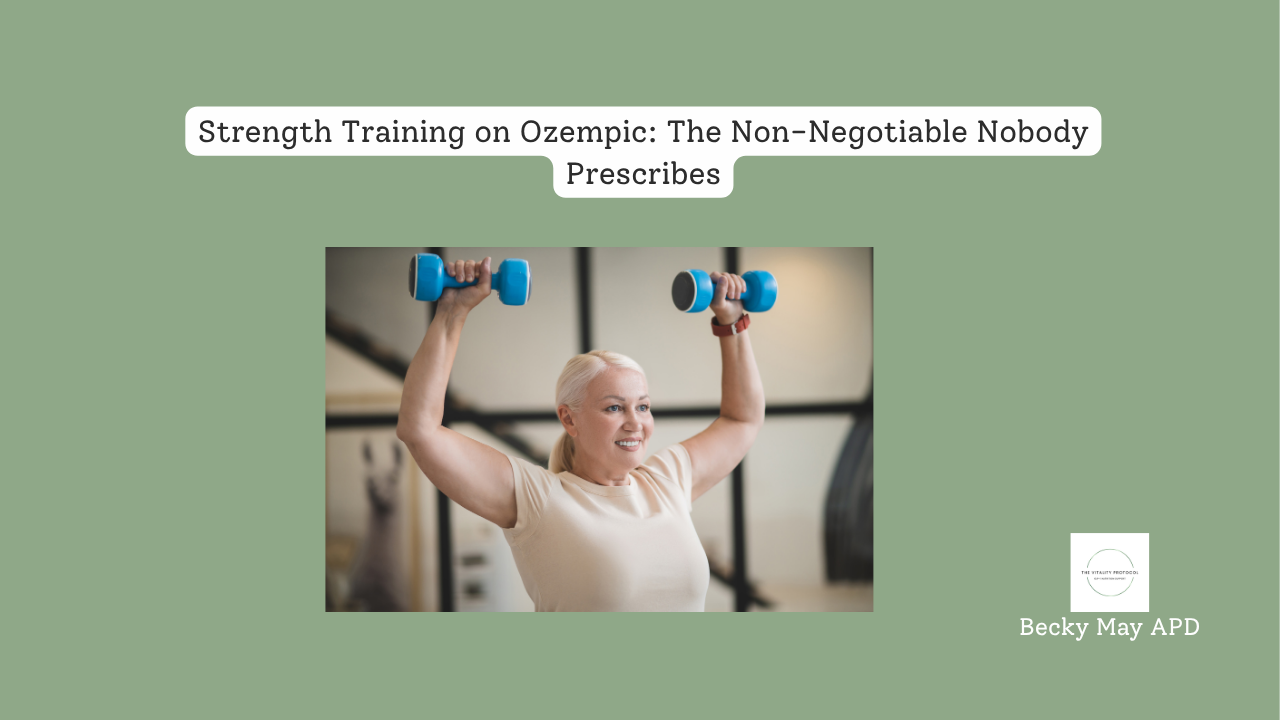
Strength training on Ozempic is the second half of muscle protection: without regular resistance work, your body has no reason to keep muscle while weight falls, no matter how well you eat. Two to three short sessions a week is enough, and you can start at home with zero equipment.
I'm an Accredited Practising Dietitian. Exercise prescription belongs with exercise professionals and your GP, but no honest GLP-1 nutrition plan can skip this topic, so here is the plain-language case and a sensible starting point.
Why lifting matters specifically during weight loss
Your body is pragmatic. In an energy deficit it sheds whatever tissue seems unnecessary, and muscle that is never challenged looks unnecessary. Research on weight loss consistently finds that people who resistance train during a deficit keep substantially more lean mass than people who do not, and the effect stacks with adequate protein.
Cardio does not do this job. Walking is wonderful for health, digestion and mood, and I recommend it daily, but it does not send a strong muscle-retention signal. The signal comes from working muscles against meaningful resistance: weights, bands, or your own body.
The stakes are laid out in muscle loss on Ozempic: unprotected rapid loss can take a large bite of lean mass, and for women over 40 that compounds an already-running decline.
"But I have no energy to train"
This is the honest objection, and it deserves an honest answer. Early on, and during dose-increase weeks, you may be eating very little and feeling flat. The answer is to scale the training down, not skip the concept. A 15-minute session of sit-to-stands, wall push-ups and band rows counts. The signal your muscles need is "we are still being used against load", not "we survived a bootcamp".
If fatigue is constant rather than episodic, check your protein and overall intake first (chronic under-fuelling is the usual cause) and raise it with your prescriber.
A sensible starting structure
Two days a week, 20 to 30 minutes, full body. For example:
- Sit-to-stands from a chair (builds to squats): 2 to 3 sets of 8 to 12
- Incline or wall push-ups (builds to floor): 2 to 3 sets of 8 to 12
- Bent-over rows with a resistance band or water bottles: 2 to 3 sets of 8 to 12
- Glute bridges: 2 to 3 sets of 10 to 15
- Farmer's carry with shopping bags or dumbbells: 3 walks of 20 to 30 metres
Progress by adding repetitions, then weight. When an exercise feels easy for all sets, it's time to make it slightly harder. That progression, not any particular exercise, is what drives the muscle-retention signal.
If you are new to training, have joint issues, or any relevant health condition, a session or two with an accredited exercise physiologist (Medicare-subsidised in some care plans) or a qualified personal trainer is money well spent. Correct form learned early prevents problems later.
Protein and training: schedule them together
A practical pattern my clients like: train, then have your protein-forward meal or shake afterwards. It pairs the stimulus with the supply and turns two habits into one routine. On training days especially, hit the upper end of your protein target.
There is a bonus most women do not expect: strength work is one of the better answers to a weight loss plateau, because preserved muscle keeps your energy expenditure higher while the scale pauses.
Where this fits in the system
Muscle-first has two levers, and this is the one nutrition only articles usually only acknowledge with a sentence. It deserves more than a sentence. Protein targets, training, side-effect management and the transition plan for life after medication all connect, and the map is at GLP-1 dietitian Australia.
The free Muscle-First Checklist includes the minimum effective training habit alongside the four nutrition non-negotiables.
FAQ
How many days a week should I strength train on Ozempic? Two to three. Research on lean mass preservation shows benefits at this frequency, and it is sustainable alongside low energy weeks. Consistency across months beats intensity in any single week.
Can I just walk instead of lifting? Walk as well, not instead. Walking supports digestion, mood and heart health but provides little muscle-retention stimulus. The combination of daily walking plus two resistance sessions covers both jobs.
Do I need a gym membership? No. Bodyweight and a $10 resistance bands cover months of progression: sit-to-stands, push-up variations, rows, bridges and carries. A gym becomes useful later, when you outgrow home resistance.
Is it safe to strength train while losing weight quickly? For most people yes, scaled to your capacity, but clearance questions belong with your GP, especially with joint, heart or blood pressure conditions. Start small, progress gradually, and fuel it with adequate protein.
Becky May, Accredited Practising Dietitian (APD). This article is education, not an individualised exercise or medical prescription. See your GP or an accredited exercise physiologist for personal advice.